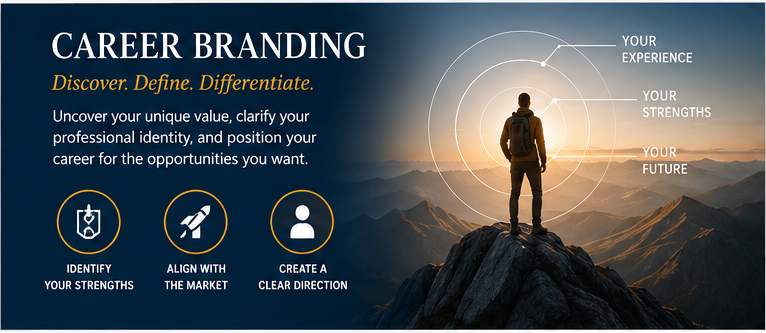
Comprehensive Career Branding
Define Your Professional Value Before You Try to Market It
Most professionals have a career history. Far fewer have a clearly defined career brand. After years of promotions, changing responsibilities, new employers, unexpected opportunities, and expanding expertise, it can become surprisingly difficult to explain what connects everything together. You know what you have done. The harder question is often:
What should someone remember about you professionally?
That is the purpose of career branding. Career branding identifies the strongest, most relevant themes within your professional experience and uses them to establish a consistent position across your resume, LinkedIn profile, professional biography, cover letter, interviews, and broader job search.
It is not about creating a catchy slogan. It is about making your professional value easier to understand.
What Is Career Branding?
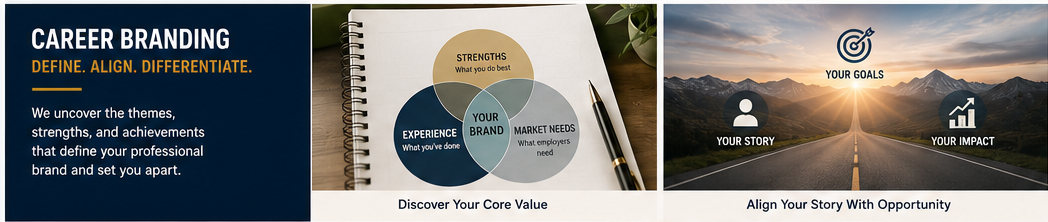
Your career brand is the intersection of three things:
What you have demonstrated you can do.
What differentiates the way you do it.
What your target market needs next.
For one professional, that may be building and transforming operations. For another, it may be developing high-performing teams, driving enterprise technology strategy, expanding revenue, strengthening customer relationships, creating new products, or guiding organizations through complex change. The strongest career brands are not invented.
They are discovered through evidence.
That evidence can include career progression, accomplishments, business results, feedback, areas of expertise, leadership responsibilities, industry knowledge, professional reputation, and the types of problems you are repeatedly trusted to solve. The objective is to identify the pattern.
Why Career Branding Should Come Before Resume Writing?
You can have an attractive resume that still lacks direction. The problem usually is not formatting. It is positioning. Without a clear career brand, a resume can become a chronological collection of everything someone has done. Important accomplishments compete with less relevant information, different positions seem disconnected, and the reader is left to determine what makes the candidate distinctive.
Career branding creates the strategy that helps prevent that. Before developing the resume, we can ask:
What opportunities are you pursuing?
What do those employers need?
Which parts of your experience provide the strongest evidence of alignment?
What accomplishments distinguish you?
What should receive greater emphasis?
What should receive less?
And what is the larger professional story connecting those decisions?
Once that positioning is established, Professional Resume Writing can translate the strategy into a focused career document.
The Career Branding Process
1. Discovery
The process begins with your career, not a template. We examine your professional history, responsibilities, accomplishments, career progression, leadership experience, strengths, target positions, and future direction. This is often where important information surfaces. Professionals often underestimate their accomplishments because they have become accustomed to the work. What feels routine today may actually reflect years of expertise, leadership, judgment, or organizational trust.
The discovery process creates distance from that familiarity.
2. Accomplishment and Evidence Development
Claims need proof. If your brand includes revenue growth, where did you generate it? If it includes transformation, what did you transform? If it includes leadership, who or what did you lead? If it includes strategic thinking, what decisions demonstrate it?
We look for the evidence supporting the positioning: numbers, scale, complexity, results, recognition, progression, and examples.
3. Target-Market Alignment
Career branding should not exist independently of the market. Your positioning needs to connect your experience with the positions you want to pursue. That means examining target roles and identifying recurring expectations, terminology, competencies, leadership requirements, and business priorities.
The objective is not to reshape your background into something it is not. It is to determine which parts of your real experience are most relevant to the market you want to enter.
4. Brand Architecture
Once the evidence and target are understood, the professional positioning begins to take shape. This may include your professional identity, areas of expertise, differentiators, leadership themes, business impact, career progression, and future direction. These elements create the foundation for the rest of the career portfolio.
5. Brand Application
A career brand becomes useful when it is applied consistently. Your resume may communicate it through a professional snapshot, career highlights, competencies, and accomplishments. Your LinkedIn profile may communicate it more conversationally. An Executive Biography can develop the leadership narrative in greater depth. A Cover Letter can connect the brand to a specific employer or opportunity.
The documents should not be identical. They should be recognizable as parts of the same professional story.
Career Branding for Different Career Stages
Career branding is not reserved for executives. An early-career professional may need to establish a brand around potential, communication ability, academic accomplishments, technical capability, internships, or rapidly developing expertise. A manager may need to demonstrate the transition from individual contributor to people and operational leadership. A director may need to show increasing organizational scope, strategic influence, and cross-functional leadership. An executive may need to clarify enterprise impact, leadership philosophy, transformation experience, P&L responsibility, board interaction, or organizational legacy.
The sophistication changes with career level. The underlying question remains the same:
What evidence explains why you are valuable at the level you want to compete?
When Career Branding May Be Particularly Valuable
Career branding can become especially important when you are pursuing a promotion, changing industries or functions, returning to the market after many years, moving into leadership, targeting executive positions, or struggling to explain a career that does not follow a perfectly linear path.
It can also help when you have extensive experience and the challenge is no longer finding enough information for a resume, it is deciding what deserves to remain.
Career Branding Without Inflated Claims
A professional brand should make you more understandable, not make you sound larger than your actual experience. Words such as visionary, transformational, innovative, and strategic have little value unless the career evidence supports them. The stronger approach is to establish the claim and then prove it.
That principle carries through TK Writing's broader resume methodology: strong resume work is strategic before stylistic, and the writer's role is to clarify professional value rather than inflate experience.
Build the Strategy Before Building the Documents
Your career documents become stronger when they begin with the same strategic foundation. If you know where you want to go but struggle to define how to position your experience, Career Branding can provide a starting point.
Ready to define the professional story behind your experience? Schedule a Free Confidential Consultation
One Career. One Strategy. A Complete Professional Brand.
The Comprehensive Career Branding Package brings the major components of your career presentation together in one coordinated engagement.
Rather than developing your resume, LinkedIn profile, cover letter, biography, and interview strategy independently, each component is built around the same underlying career positioning.
Your Comprehensive Career Branding Package Includes
Professional Resume Writing — $599 Value
One-on-one intake and career-targeting consultation
Review of existing resume and career materials
Targeted accomplishment questionnaire
Review of representative target positions
Career progression and accomplishment analysis
Development of measurable achievement statements
Professional positioning and summary development
Core competency and keyword alignment
ATS-conscious professional formatting
Microsoft Word and PDF versions
Proofing and revision period
Professional Cover Letter — $99 Value
Target-position and employer review
Alignment with resume and professional positioning
Selection of relevant career evidence
Customized opening and messaging strategy
Professionally written cover letter
Adaptable framework for future opportunities
Microsoft Word and PDF versions
Professional Biography — $99 Value
Review of career history and supporting materials
Identification of important career and leadership themes
Accomplishment and professional-story development
Professionally written narrative biography
Web-ready copy
Microsoft Word and PDF versions
LinkedIn Profile Optimization — $349 Value
Existing profile review
Search-oriented professional headline
Customized About section
Experience-section recommendations and optimization
Skills and keyword strategy
Resume-to-LinkedIn alignment
Recommendations for strengthening professional visibility
Three Interview Coaching Sessions — $297 Value
Three one-on-one sessions can be used to develop your professional introduction, accomplishment stories, behavioral interview responses, leadership examples, difficult-question strategies, and preparation for specific opportunities.
Total Individual Service Value: $1,443
Comprehensive Career Branding Package: $1,199
Package Savings: $244