Cover Letter Services
A Cover Letter Should Add Something the Resume Cannot.
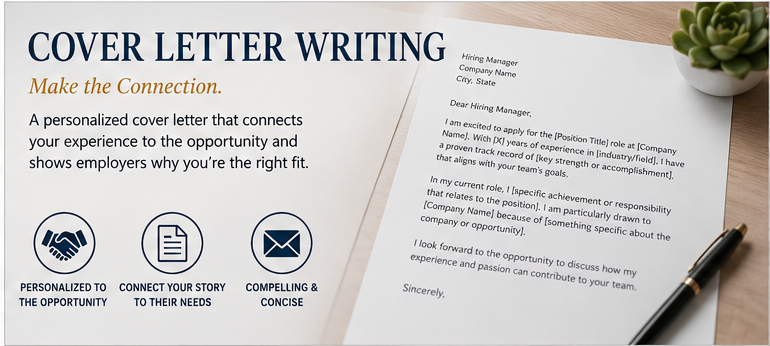
If a cover letter repeats your resume, it has missed its purpose. The employer already has the resume. A useful cover letter should help the reader understand the connection between your background, this opportunity, and this organization. That makes cover-letter writing less about summarizing your employment history and more about deciding which part of your professional story matters most for a particular opportunity. Sometimes that is an accomplishment. Sometimes it is industry expertise. Sometimes it is leadership philosophy. Sometimes it is the reason behind a career transition. Sometimes the most important thing a cover letter can do is explain a connection that isn't obvious from the resume alone.
What Is the Purpose of a Cover Letter?
A resume is primarily evidence. A cover letter provides context. It can answer questions such as: Why are you interested in this organization? Why does this particular position make sense? Which parts of your background are especially relevant? Why are you changing industries or functions? Why does an unusual career path make sense? What connects your professional values with the employer's needs? A strong cover letter gives the employer a reason to review your resume with more context.
Should You Submit a Cover Letter?
Not every application requires one. But when an employer requests a cover letter, you should generally take the instruction seriously. A cover letter may also be useful when your motivation matters, you are making a career transition, your background requires context, you have a meaningful connection to the organization, or the position is important enough to justify a more personalized approach. Make the decision strategically, not automatically.
How Professional Cover Letter Writing Works
1. Start With the Opportunity
Cover-letter development begins with the target position and organization. What is the employer looking for? What appears to matter most in the role? What business need is underneath the job description? Which parts of your experience connect most strongly? Without that context, even excellent writing can become generic.
2. Review the Career Brand
The cover letter should reinforce the same positioning established in your resume. If your Career Branding identifies you as a leader who builds scalable operations, for example, the cover letter should not suddenly present an unrelated professional identity. Consistency builds credibility.
3. Choose the Right Story
A cover letter does not have room for everything. Selection matters. The strongest letter may center on one or two highly relevant themes. For example, a candidate pursuing a turnaround leadership role might briefly explain a history of entering difficult operating environments and improving performance. Someone changing industries might focus on transferable expertise and explain why the new industry is a logical next step. An executive approaching a mission-driven organization might explain why the organization's purpose connects meaningfully with their leadership experience. The objective is relevance—not autobiography.
4. Write an Opening That Has a Purpose
Many cover letters begin with some variation of: "I am writing to express my interest in..." There is nothing technically wrong with that sentence. It simply uses valuable space to tell the employer something they already know. A stronger opening begins with substance. That might include a connection to the organization, a defining piece of experience, an important accomplishment, or why the opportunity is particularly relevant. The opening should create context for everything that follows.
5. Connect Experience to Need
The body of the letter should make the argument. What has the candidate done that relates to what this employer needs? This is where selected accomplishments can provide credibility, but they should not simply be copied from the resume. The cover letter can explain why the experience matters.
6. Address Career Transitions When Necessary
Cover letters can be particularly useful when the resume alone leaves an unanswered question. Perhaps you are moving from healthcare into corporate operations. Perhaps you are leaving entrepreneurship for corporate leadership. Perhaps you are returning to an industry after several years away. Perhaps geography is changing. Your next position may be a deliberate step down in organizational level or a move toward a different type of work. The cover letter provides room to make the logic clear rather than asking the employer to guess.
7. Close Professionally
The conclusion does not need to be dramatic. It should reinforce interest, connect the candidate's value with the opportunity, and create a natural opening for further conversation. Confidence works better than excessive enthusiasm.
The Relationship Between the Cover Letter and Resume
The Professional Resume provides the evidence. The cover letter interprets selected evidence for this particular employer. For example: Resume: Led a $40M operating portfolio across six locations, improving EBITDA while restructuring underperforming operations. Cover letter: My experience leading multi-location operations has repeatedly required balancing financial performance with the people and operational decisions necessary to sustain it. That combination is particularly relevant to your organization's current expansion... The facts are consistent. The function is different.
What a Cover Letter Should Avoid
The strongest letters generally avoid excessive flattery, generic enthusiasm, clichés, unsupported claims, long summaries of every previous position, and language that could have been sent to any employer. They should also avoid sounding artificially formal. The person who appears for the interview should sound reasonably similar to the person represented in the letter.
AI and Cover Letters
AI can make cover-letter generation extraordinarily fast. That is useful—and potentially problematic. If the same tool is given the same job description and similar candidate information, it can easily produce the same familiar language: enthusiasm for the opportunity, admiration for the organization's reputation, and broad claims about alignment. The result may be grammatically polished while communicating very little. AI is more useful when it helps organize specific, truthful information. The differentiator remains the candidate's actual story. What connects you to this opportunity? What experience proves the connection? Why does this move make sense? Those answers should drive the letter.
Adaptable Does Not Mean Generic
A strong foundational cover letter can be adapted for multiple opportunities. But adaptation needs to be meaningful. Employer name and job title should not be the only things that change. The opening, selected evidence, organizational connection, and emphasis may need adjustment depending on the opportunity. The foundation can remain consistent. The argument should become specific.
The Final Product
TK Writing's current Cover Letter service includes an intake and targeting session, a professionally developed letter delivered in Microsoft Word and Adobe PDF formats, a five-business-day proofing period, and two weeks of revisions. The final letter shouldn’t just say you want the job. It should help the employer understand why a conversation with you makes sense.
Connect Your Experience to the Opportunity
A strong cover letter should not simply repeat your resume.
It should help an employer understand why your experience makes sense for a particular opportunity.
The letter is developed around your professional positioning and relevant career evidence, with an adaptable structure that can be customized for future applications.
Your Professional Cover Letter Includes
Review of your resume and career positioning
Review of a representative target opportunity
Identification of the strongest employer/candidate connection
Selection of relevant accomplishments and supporting evidence
Customized opening strategy
Professionally written cover letter
Adaptable structure for future applications
Microsoft Word version
Adobe PDF version
Client proofing and revision period
Investment: $99
Best for: Professionals pursuing an important opportunity, making a career transition, changing industries, or needing to explain information that cannot be communicated as effectively through the resume alone.
Also included in the $1,199 Comprehensive Career Branding Package.